Introduction
One of the most common questions we get from business owners in Arizona is: should we move everything to the cloud, or stick with our on-premise servers?
The honest answer? It depends on your business. But by the end of this article, you’ll have a clear framework to make the right decision for your specific situation.
Understanding Your Options
Before we compare, let’s define what we’re talking about:
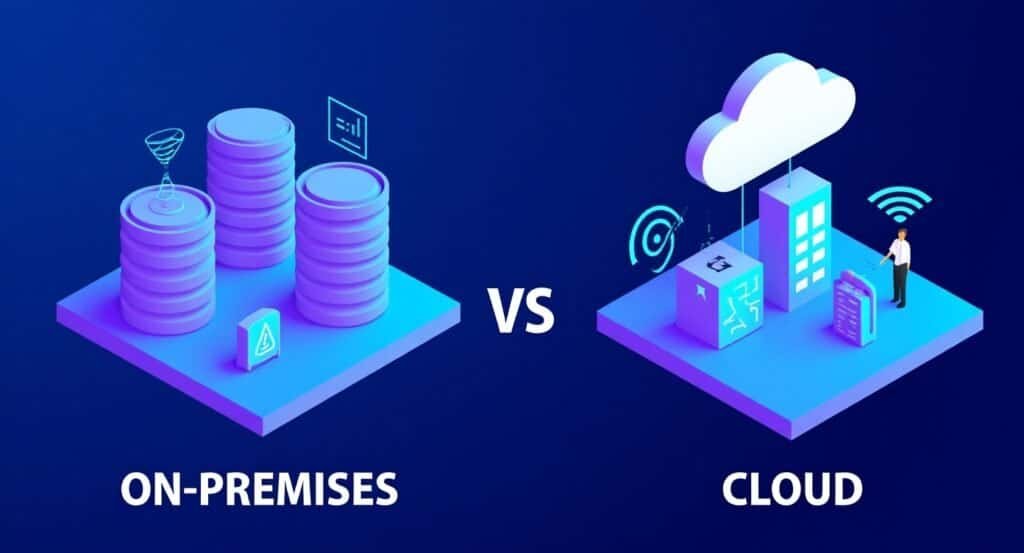
On-Premise IT
Your servers, storage, and applications are physically located in your office or a data center you control. You own the hardware, you manage it, and your data stays on your site.
Cloud IT
Your servers, storage, and applications are hosted by a third-party provider — like Microsoft Azure, Amazon Web Services, or Google Cloud — and accessed over the internet.
Hybrid IT
A combination of both — some systems in the cloud, others on-premise — which is increasingly the preferred approach for many businesses.
Cost Comparison
On-Premise Costs
- High upfront capital expenditure (servers, networking equipment, UPS systems)
- Ongoing maintenance, repairs, and hardware replacement
- Power and cooling costs
- IT staff to manage and maintain systems
- Typical 3-5 year hardware refresh cycle
Cloud Costs
- Low upfront cost — pay as you go
- Predictable monthly subscription fees
- No hardware maintenance costs
- Built-in redundancy and disaster recovery
- Scale up or down based on your needs
Winner for most small businesses: Cloud: the elimination of large capital expenditures and predictable monthly costs make cloud more financially accessible for growing businesses.
However, for businesses with very specific compliance requirements or large data volumes, on-premise can sometimes be more cost-effective long-term.
Security Comparison
This is where most business owners have concerns about the cloud — and it’s a legitimate consideration.
On-Premise Security
- Complete control over your data and who accesses it
- No dependence on internet connectivity for security
- Easier to meet certain compliance requirements (though not always)
- Vulnerable to physical theft, natural disasters, and local hardware failures
- Security is entirely your responsibility
Cloud Security
- Enterprise-grade security infrastructure that most businesses couldn’t afford to build themselves
- Data centers with 24/7 physical security, biometric access, and redundant systems
- Regular third-party security audits
- Built-in encryption, access controls, and compliance certifications
- Shared responsibility model — the provider secures the infrastructure, you secure your data and access
The reality: Major cloud providers invest billions of dollars in security annually. For most small and mid-sized businesses, cloud environments are significantly more secure than self-managed on-premise servers.
Scalability and Flexibility
On-Premise
Scaling up means buying more hardware — expensive, time-consuming, and often done reactively. If you suddenly need more storage or computing power, you might wait weeks for new equipment to arrive and be configured.
Cloud
Scale up or down in minutes. Adding a new user, increasing storage, or deploying a new application takes clicks, not weeks. This flexibility is invaluable for growing businesses or those with seasonal fluctuations.
Winner: Cloud — no question.
Reliability and Uptime
On-Premise
Your uptime depends on the quality of your hardware, your power supply, and your IT team’s ability to respond to failures. If your server room floods or your hardware fails at 2am, you’re down until someone fixes it.
Cloud
Major cloud providers guarantee 99.9% to 99.99% uptime, backed by service level agreements. They have multiple redundant data centers, automatic failover systems, and 24/7 operations teams keeping your services running.
Winner: Cloud for most businesses.
Compliance Considerations
Certain industries — healthcare (HIPAA), finance (PCI-DSS), legal — have strict requirements about data handling and storage.
The good news: major cloud providers like Microsoft Azure offer compliance certifications including HIPAA, PCI-DSS, SOC 2, and more. Healthcare organizations regularly use HIPAA-compliant cloud environments.
However, if your compliance requirements are very specific or you operate in a highly regulated industry, consult with an IT compliance specialist before making the move.
What’s Right for Your Business?
Choose Cloud If You:
Choose cloud if you have fewer than 200 employees, have remote or hybrid workers, want predictable monthly IT costs, need to scale quickly, don’t have dedicated on-site IT staff, or want built-in disaster recovery.
Consider On-Premise If You:
Consider on-premise if you have very specific data sovereignty requirements, process extremely large amounts of data locally, have specialized applications that don’t run in the cloud, or have an existing infrastructure investment you’re not ready to retire.
Consider Hybrid If You:
Consider hybrid if you have some cloud-ready workloads and some legacy systems, want the security of on-premise for sensitive data with cloud flexibility for everything else, or are in the process of transitioning to the cloud over time.
The NetProtechs Recommendation
For the vast majority of Arizona small and mid-sized businesses we work with, a cloud-first or hybrid approach delivers the best combination of cost efficiency, security, and flexibility.
We help businesses migrate to Microsoft Azure and AWS, design hybrid environments, and manage cloud infrastructure — all with the same flat-rate pricing and 24/7 support our clients expect.
Not sure which path is right for you? Schedule a free IT assessment and we’ll analyze your current infrastructure and give you a clear, unbiased recommendation.